Dinners for a Crowd: The Complete 2025 Playbook


Hosting a large group should be a joy, not a test of endurance. Yet, for many home cooks, the thought of preparing dinners for a crowd—whether it’s 10 people or 50—can be overwhelming. The fear is real: “Will I have enough food? What about allergies? How do I keep everything warm? And how do I avoid a mountain of debt and dishes?”
If this sounds familiar, you are in the right place. Cooking for a crowd isn’t just about multiplying a recipe by ten. It is a true test of planning, strategy, and execution.
In 2025, the landscape of group dining has evolved. It’s no longer just about serving a massive pot of spaghetti. Today’s guests are more mindful of sustainability, have a wider range of dietary needs, and crave experiences. The good news? These trends can actually make your job as the host easier.
This is your ultimate guide. We will walk you through every single step, from the first spark of an idea to the final, satisfied guest. We will cover flawless planning, smart budgeting, crucial food safety, and the modern trends that will make your event memorable. Prepare to move from a place of panic to one of cool, collected confidence.
The Foundation: Flawless Planning for Large Group Dinners
You cannot successfully cook for a crowd on impulse. A great large-scale dinner is 90% planning and 10% execution. Get this part right, and the cooking part becomes a simple matter of following your own expert instructions.
Table of Contents
Define Your “Why”: The Event & Audience
First, ask why you are hosting. The answer dictates everything. A casual backyard birthday party for 30-somethings has a completely different menu, budget, and service style than a formal holiday dinner for an extended family of all ages.
- Formal vs. Informal: Will guests be seated at one time, or will they graze over several hours? A buffet is best for grazing, while a “family-style” service (placing large platters on tables for guests to share) works beautifully for a seated meal.
- Time of Day: A late-afternoon event might only require heavy appetizers and drinks. A 7 PM dinner implies a full, multi-course meal.
- Location: Do you have a large kitchen with double ovens, or are you working with a small apartment kitchen and a grill? Be realistic about your space. This will define the type of menu you can execute.
The “Who”: Mastering Dietary Restrictions
This is the new, non-negotiable rule of modern hosting: you must ask about dietary needs. In 2025, “inclusive eating” is the standard. It is no longer acceptable to hope for the best.
When you send your invitation, include a simple line: “Please let me know of any serious food allergies or dietary restrictions (e.g., celiac, vegan, nut allergy) by [Date] so I can plan a delicious menu for everyone!”
Real-world Example: You plan a “Build Your Own” Taco Bar. This is a brilliant strategy.
- For Gluten-Free: You offer corn tortillas alongside flour.
- For Vegans: You provide a robust “black bean and roasted sweet potato” filling, not just the “salad” toppings.
- For Nut Allergies: You ensure your “mole” sauce (if using) is nut-free, or you label it clearly.
Your goal is not to create a separate, sad-looking meal for each restriction. Your goal is to design a main menu that is naturally inclusive.
The “What”: Smart Menu Curation
Now is not the time to test that complex, 12-step Beef Wellington you saw on a cooking show. Your best friends when cooking dinners for a crowd are:
- Make-Ahead Dishes: Chilis, stews, braised meats (like pulled pork), and lasagna are all better when made a day in advance. This frees up your stove and your sanity on the event day.
- Room-Temperature-Friendly: Choose sides that taste great at room temperature. Think: quinoa salads, marinated vegetable platters, robust pasta salads, or roasted root vegetables. This solves the “how to keep 10 things hot” problem.
- One-Pot or One-Pan Wonders: Think large-scale paella, a massive pot of jambalaya, or sheet-pan dinners (which can be scaled across multiple pans).
A smart menu has a large “anchor” dish (like a big roast or a pot of chili), one or two hot sides, two or three room-temperature sides/salads, bread, and a simple dessert.
The “How Much”: The Golden Rules of Portion Planning
This is the number one source of hosting anxiety. Use these professional catering guidelines as your base. It is always better to have planned leftovers than to run out of food.
The Per-Person Math:
- Protein (Main Dish):
- Boneless Meat (e.g., pulled pork, chicken breast): 6-8 ounces (by weight) per person. For 20 people, that’s 10 pounds of uncooked pork shoulder.
- Bone-In Meat (e.g., chicken pieces): 10-12 ounces (by weight) per person.
- Side Dishes (Starch/Veg):
- Plan on 1.5 to 2 side dishes per person, total.
- Potatoes/Pasta/Rice: 1/2 to 3/4 cup (cooked) per person.
- Vegetables/Salad: 1 cup per person.
- Appetizers: If serving before the meal, plan 3-4 “bites” per person. If appetizers are the meal, plan 10-12 bites per person.
- Dessert: 1.5 servings per person (e.g., for 20 people, have 30 brownies or one large sheet cake).
- Drinks: Plan 2-3 drinks per person for the first hour, and 1-2 drinks per hour after that.
Pro Tip: Always round up. If your math says 28 people, plan for 30.
Budgeting Without Compromise: How to Feed a Crowd Affordabl
The cost of groceries in 2025 can easily spiral. Hosting a “dinner for a crowd” does not have to mean an empty wallet. A professional, practical approach to budgeting is key.
The Power of the “Per-Head” Budget
Start by setting a realistic “per-head” cost. Be honest. Can you afford $10 per person or $30 per person?
- $10/head ($200 for 20 people): This is your “Budget-Friendly All-Stars” menu. Think chili cook-off, a giant baked potato bar, or a hearty pasta buffet.
- $30/head ($600 for 20 people): This allows for more expensive cuts of meat (like a beef roast or salmon), a wider variety of appetizers, and premium ingredients.
Setting this number first stops you from pinning recipes for “Individual Lobster Pot Pies.”
Smart Shopping: Bulk Buys vs. Fresh Finds
Do not walk into your regular grocery store an hour before the party and expect to stick to a budget.
- Two Weeks Out (Bulk): Shop at a warehouse club for non-perishables. This includes grains (rice, quinoa, pasta), canned goods (tomatoes, beans), all of your drinks, paper goods, cooking oils, and spices.
- Two Days Out (Fresh): Shop at your local market for produce, dairy, and meat. This ensures freshness and prevents you from buying items you “might” need. Stick to your list.
The Budget-Friendly All-Stars
Some ingredients were made for feeding a crowd. Build your menu around these:
- Pork Shoulder: Inexpensive, versatile, and forgiving. It’s perfect for pulled pork, carnitas, or a slow roast.
- Chicken Thighs: More flavorful and cheaper than breasts. Ideal for sheet-pan bakes, stews, and curries.
- Legumes & Beans: The ultimate budget-stretcher. A hearty lentil soup or a three-bean chili can be a main event.
- Potatoes & Root Vegetables: Cheap, filling, and easy to roast in large batches.
- Pasta & Rice: The classic crowd-fillers.
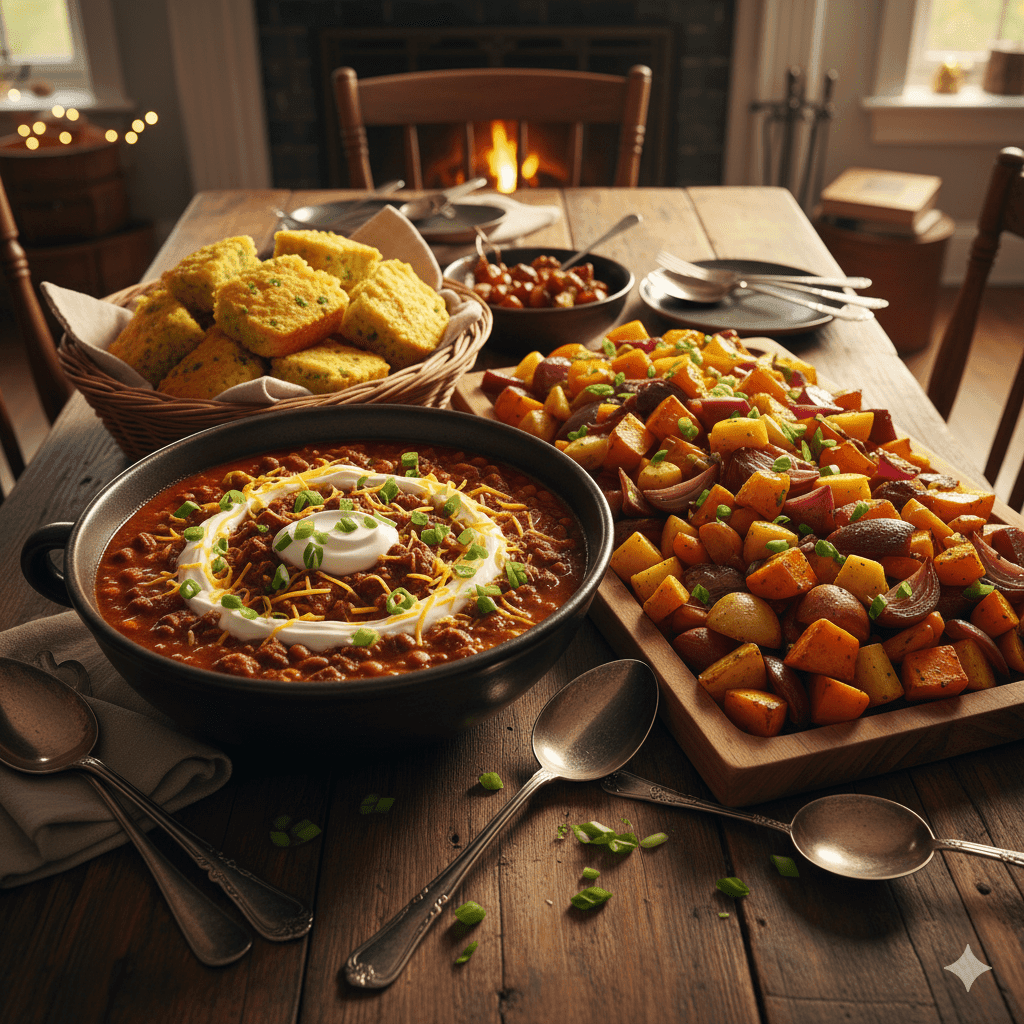
[Image Placement #1: A rustic, beautiful shot of a large wooden table filled with “budget-friendly” dishes: a big bowl of chili, a platter of roasted root vegetables, and a basket of cornbread. The feeling is abundance and warmth.]
The Hidden Cost-Saver: Reducing Food Waste
This is the biggest budget and sustainability win of 2025. Wasting food is wasting money—period.
- The Shocking Stat: The UN Environment Programme (UNEP) Food Waste Index Report 2024 found that households are responsible for 60% of the 1.05 billion tonnes of food wasted globally.
- Plan Your Leftovers: Don’t just have leftovers; plan for them. Buy a stack of attractive, recyclable to-go containers. As the party winds down, pack up leftovers and send them home with your guests. They will be thrilled, and you won’t be staring at 5 pounds of congealed pasta for a week.
- “Stock-to-Shop”: Before you buy a new bottle of olive oil, check your pantry. Use what you have first.
The 2025 Host: Top Trends for Dinners for a Crowd
Hosting in 2025 is about more than just food; it’s about the experience. These trends are popular because they are fun for guests and surprisingly practical for hosts.
Trend 1: The Rise of the “Interactive Food Station”
This is the single best strategy for a low-stress dinner for a crowd. You do the prep; your guests do the assembly. It’s engaging, handles dietary needs automatically, and moves the “service” pressure from you to the guest.
- Taco/Nacho Bar: Ground beef, shredded chicken, black beans, queso, salsas, lettuce, cheese, jalapeños.
- Baked Potato Bar: Big baked potatoes (russets and sweet potatoes), chili, broccoli, cheese, bacon, sour cream, green onions.
- Pasta Bar: Two pasta shapes, two sauces (one red, one white/pesto), and bowls of toppings like mini meatballs, roasted vegetables, and parmesan.
Trend 2: Inclusive & “Free-From” Menus
As we covered in planning, this is now a core expectation. A 2025 trend report for events highlights that “inclusive menus everyone can enjoy” are table stakes. This means having legitimate, delicious options for your vegan, vegetarian, gluten-free, and dairy-free guests. The “interactive bar” concept is a perfect solution.
Trend 3: Elevated Non-Alcoholic Beverages
The “soda and water” bar is dead. A growing number of guests are sober-curious, health-conscious, or simply want something more interesting.
- The Solution: Create one “feature” non-alcoholic drink in a large glass dispenser.
- Example: A sparkling “mocktail” of cranberry juice, fresh rosemary, a splash of orange juice, and sparkling water. It looks beautiful, feels adult, and is incredibly simple to batch.
Trend 4: Sustainability as a Centerpiece
Guests, especially in 2025, are aware of the impact of large gatherings.
- Ditch the Disposables: If you can, use real plates and cutlery. It elevates the entire event. If you must use disposables, opt for high-quality, compostable bamboo or palm leaf plates.
- Go Local: This isn’t just a restaurant trend. A recent study noted 78% of consumers prefer locally sourced ingredients. Hit your local farmer’s market for your produce. It’s a great story (“The tomatoes in the salad are from [Local] Farm!”), and it supports your community.
The Cook’s Playbook: Prep, Timing, and Execution
This is your “Day of Battle” plan. A well-timed event looks effortless, but it’s built on a foundation of military-precision scheduling.
Your Most Valuable Asset: The Prep Timeline
Do not try to do everything on the day of the party. You will fail.
- T-3 Days: Finalize your menu and create your shopping lists (one for bulk, one for fresh).
- T-2 Days: Go on your “bulk” shopping trip. Make any sauces, salad dressings, or marinades that store well.
- T-1 Day (The “Golden Day”): This is your main prep day.
- Go on your “fresh” shopping trip in the morning.
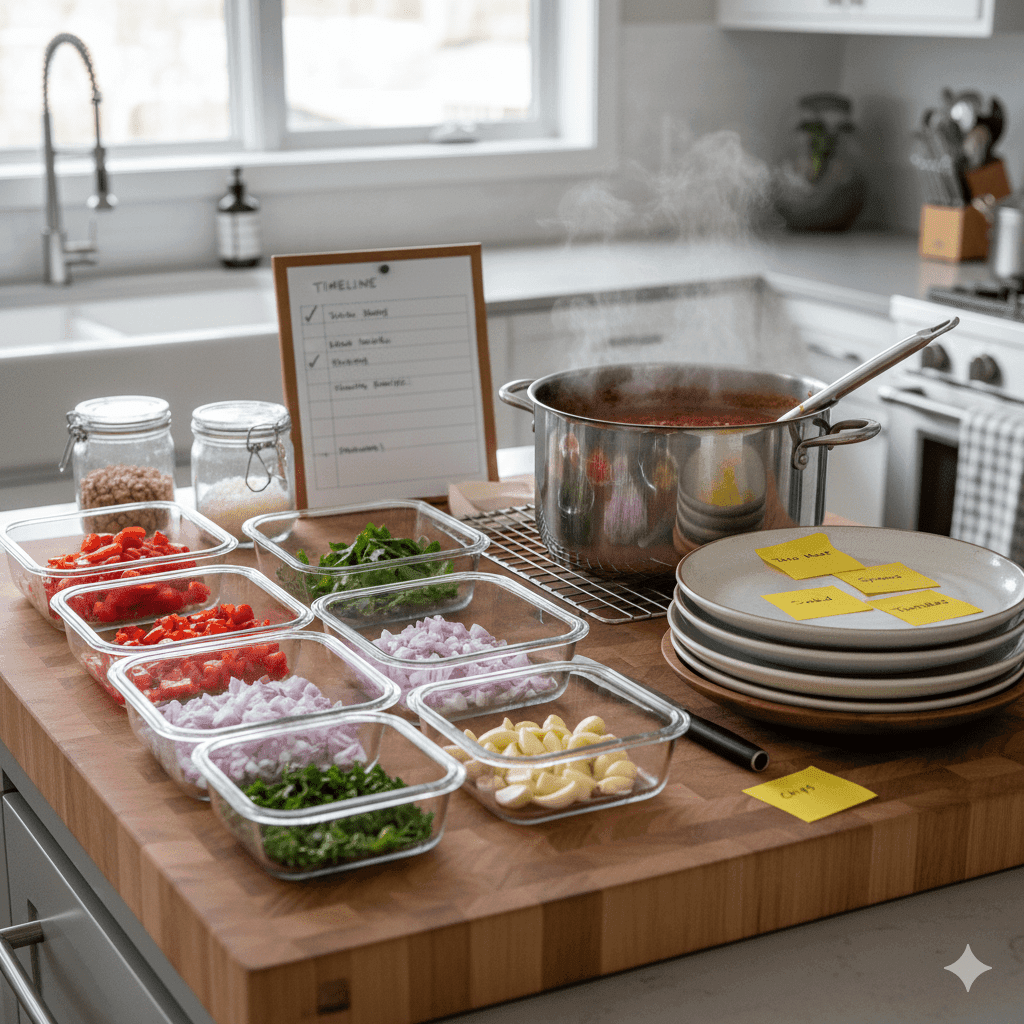
- Chop all your vegetables. Store them in airtight containers. (This is your mise en place).
- Make any dish that can be refrigerated and reheated (chili, stews, lasagna).
- Set the table.
- Set up the “beverage station.”
- Label your serving dishes with sticky notes (“Taco Meat,” “Salad,” “Spoons”) so you know exactly where everything goes.
- Day Of: All you are doing is managing and reheating.
- 6 Hours Out: Assemble any “cold” dishes (like pasta salads).
- 3 Hours Out: Remove refrigerated dishes to come to room temp before reheating.
- 1 Hour Out: Begin reheating. Put out all room-temperature dishes.
- 15 Mins Out: Do a final “walk-through,” light candles, and pour yourself a drink.
The “Mise en Place” Philosophy, Magnified
Mise en Place is a French culinary term meaning “everything in its place.” For a home cook, it means chopping all your onions, peppers, and garlic, measuring all your spices, and having every component ready before you turn on the heat. For a crowd, this is your lifeline. Your “T-1 Day” is dedicated to creating the mise en place for your entire event.
Managing the “Oven Traffic Jam”
Your oven is your most valuable and limited resource.
- Don’t Plan 3 Dishes That All Need to Bake at 400°F: Plan a menu that uses all your appliances.
- Leverage Your Tools:
- Slow Cooker: Use it to keep things hot (like chili or mashed potatoes) after they are cooked. Do not use it to reheat.
- Stovetop: Perfect for reheating soups, stews, and sauces.
- Grill: Takes an entire category of food (meats, vegetables) outside, freeing up the kitchen completely.
- Air Fryer/Toaster Oven: Excellent for crisping appetizers or toasting bread.
The Art of Staging: Buffet vs. Family Style
How you serve the food matters.
- Buffet: Best for large, mixed crowds and “grazing.”
- Pro Tip: Create a “two-sided” buffet (if on a central island) to double the speed of the line.
- Flow: Plates first, then salads, then main dishes, then sides, then cutlery (so guests aren’t juggling).
- Family Style: Best for seated dinners. Place large, beautiful platters on the tables and let guests serve themselves. This fosters a wonderful, communal, and celebratory atmosphere.
[Image Placement #2: A shot of a “T-1 Day” prep scene. Neatly chopped vegetables in clear containers, a pot of sauce cooling, and serving platters lined up with sticky notes. The image should convey organization and calm control.]
Food Safety at Scale: The Non-Negotiable Rules
When you’re cooking for anyone other than yourself, you are responsible for their well-being. Food safety is not optional. The risk of foodborne illness increases dramatically with large-batch cooking.
The “Danger Zone”: The 2-Hour Rule (40°F – 140°F)
This is the most important rule. The “Danger Zone” is the temperature range where bacteria (like Staphylococcus and Salmonella) multiply fastest.
- The Rule: Never leave perishable food (meat, dairy, cooked casseroles, cut fruit) at room temperature for more than 2 hours.
- On a Hot Day (above 90°F): This window shrinks to 1 hour.
- Solution: Use chaffing dishes for a hot buffet, or put serving platters in ice baths for a cold buffet. If not, rotate food—put out smaller amounts and replenish from the fridge or oven.
The Right Way to Thaw
Never, ever thaw a large turkey, roast, or pack of chicken on the kitchen counter. The outside thaws and enters the “Danger Zone” while the inside is still frozen.
- Safest Method (Fridge): This is the only truly safe way. It takes time. Plan 24 hours for every 4-5 pounds of meat.
- In a Pinch (Cold Water): You can thaw in a sink of cold water, but you must change the water every 30 minutes.
The Cooling-Down Conundrum
You just cooked a 10-gallon pot of chili. You cannot put that pot directly in the fridge. The food in the center will stay in the “Danger Zone” for hours, breeding bacteria.
- The Solution: You must increase the surface area. Divide the hot food into several shallow containers (food should be no more than 2 inches deep).
- Ice Bath: For speed, place these shallow pans in an ice bath in the sink before refrigerating.
[Image Placement #3: A clear, instructional infographic showing the “Danger Zone” thermometer. 40°F to 140°F is highlighted in red. Include icons for “Cool food in shallow pans” and “Reheat to 165°F.”]
Reheating Leftovers: The 165°F Rule
When you reheat food, you must do it quickly and thoroughly.
- The Rule: All leftovers must be reheated to an internal temperature of 165°F. A food thermometer is your best friend.
- Slow Cookers: Do not use a slow cooker to reheat food. They heat too slowly, allowing the food to spend hours in the “Danger Zone” again. Reheat on the stove or in the oven, and then transfer to a slow cooker set to “Warm” or “Low” to hold it.
Recipe Concepts: 3 Fail-Safe Menus for a Crowd
Here are three complete menu concepts that are budget-friendly, crowd-pleasing, and follow all the rules we’ve discussed.
Menu 1: The “Build-Your-Own” Taco Bar (The Crowd-Pleaser)
- Main: Slow-Cooker Carnitas (Pork) AND/OR Shredded Chicken.
- Vegetarian Main: Spiced Black Bean & Sweet Potato Filling.
- Bases: Hard Shells, Soft Corn Tortillas, Soft Flour Tortillas.
- Toppings (All in separate bowls): Shredded Cheese, Crumbled Cotija Cheese, Shredded Lettuce, Diced Onions, Cilantro, Pickled Jalapeños, Sour Cream, Guacamole, Multiple Salsas.
- Prep: All meats and the bean filling can be made 1-2 days ahead. All toppings can be chopped the day before.
Menu 2: The “Elevated Comfort” Pasta Buffet (The Budget-Friendly)
- Main 1: A large tray of Baked Ziti with Sausage (Can be made T-1 Day).
- Main 2: A “Free-From” Pasta. Cook a gluten-free pasta and serve it with a beautiful, vegan pesto (nut-free, using pumpkin seeds) and a bowl of roasted vegetables.
- Side: A massive Caesar Salad (make the dressing T-1, toss right before serving).
- Side: Garlic Bread (buy in bulk, toast in the oven right before dinner).
- Prep: The baked ziti must be made the day before. It slices cleaner and tastes better.

Menu 3: The “Hearty & Healthy” Chili Cook-Off (The Make-Ahead King)
- Main 1: A large pot of Classic Beef & Bean Chili (Make T-2 Days).
- Main 2: A large pot of White Bean Chicken Chili (Make T-2 Days).
- Main 3: A pot of Vegan Lentil & Vegetable Chili (Make T-2 Days).
- Bases: Jars of Fritos (for “Frito Pie”), bowls of cooked rice.
- Side: Skillets of “Jalapeño-Cheddar” Cornbread (can be baked T-1 Day).
- Toppings Bar: Shredded cheese, sour cream, green onions, jalapeños, avocado.
[Image Placement #4: A vibrant, top-down shot of the “Build-Your-Own” Taco Bar. Colorful bowls of toppings, platters of meat, and stacks of tortillas. It should look fun, abundant, and interactive.]
Your Success Is in the Plan
Cooking dinners for a crowd is not a test of your culinary genius. It is a test of your planning and organization.
By following this guide, you are setting yourself up for success. Choose a menu that can be prepped ahead. Embrace the 2025 trends of interactive, inclusive, and sustainable dining. Be a stickler for food safety. Most importantly, create a timeline that allows you to be a host, not just a cook.
When you do the work upfront, you give yourself the greatest gift: the ability to relax, to connect with your guests, and to actually enjoy the wonderful, communal, and memory-making event you’ve worked so hard to create.
Call to Action
Feeling inspired? Your next step is to choose your menu.
Check out our complete, crowd-tested recipes for a [Build-Your-Own Taco Bar] and [The Ultimate Make-Ahead Baked Ziti] to get started!
Frequently Asked Questions (FAQ)
1. What is the biggest mistake people make when cooking for a crowd? The most common mistake is choosing the wrong menu. People select complex, “à la minute” recipes that require individual cooking. This leads to stress, poor timing, and a host who is trapped in the kitchen. The second biggest mistake is failing to create a prep timeline.
2. How do I keep all the food hot at the same time? You don’t! A smart menu includes dishes that are meant to be served at different temperatures. Plan for one or two “hot-hot” main dishes (kept warm in a slow cooker or oven), and complement them with salads, marinated vegetables, bread, and dips that are served at room temperature.
3. What’s the best way to handle alcohol on a budget? The 2025 trend is to offer “better,” not “more.” Instead of a full, open bar, offer two “signature” drinks (one alcoholic, one non-alcoholic) in large-batch dispensers. Supplement this with a selection of beer and wine. This is far cheaper and more stylish than a random assortment of spirits.
4. How do I scale a recipe for a large group? You can’t always multiply a 4-person recipe by 10. Spices, for example, don’t scale linearly (10x the salt will be inedible). Use an online recipe scaling calculator, and always scale your seasonings to taste. It’s better to make 3 batches of a recipe you know (in 3 separate pans) than one giant, untested mega-batch.
5. How much ice do I need? You need more ice than you think. A lot more. The rule of thumb is 1.5 to 2 pounds of ice per person. This covers ice for drinks and ice for keeping any platters or beverages cold. It’s the one thing you can’t make yourself and will always run out of. Buy it.