

How to Address an Envelope to a Married Couple: The Complete 2025 Guide
In our fast-paced digital world, sending a physical piece of mail whether it’s a wedding invitation, a holiday card, or a heartfelt thank you note carries more weight than ever. It’s a tangible gesture of connection. But that special touch can be quickly overshadowed by a moment of uncertainty: How, exactly, do you address the envelope? The rules of etiquette are evolving, and knowing how to address an envelope to a married couple in 2025 requires a blend of timeless tradition and modern sensibility.
You’ve selected the perfect card, written a thoughtful message, and now you’re poised with a pen, ready to complete the final step. Getting it right shows respect, care, and attention to detail. This comprehensive guide will walk you through every scenario, from the deeply traditional to the beautifully modern, ensuring your mail always makes the perfect first impression.
Table of Contents
The Foundations of Envelope Etiquette: Why It Still Matters in 2025
You might wonder if anyone truly notices the specific format on an envelope anymore. The answer is a resounding yes. The way you address an envelope sets the tone for the contents within. It’s the first thing your recipients see, and it communicates the formality and importance of the occasion before the seal is even broken.
In a world saturated with emails and text messages that are opened and forgotten in seconds, physical mail has a surprising staying power. Recent data highlights this trend:
- A 2024 study by the Postal Service showed that 75% of recipients report that receiving personal mail makes them feel special.
- Direct mail, including invitations and cards, boasts an average open rate of up to 90%, dwarfing the 20-30% average open rate for emails.
This isn’t just about getting your message seen; it’s about making your recipients feel valued. Taking a moment to consider their titles, names, and relationship shows a level of personal respect that a quick digital message simply can’t replicate. Whether you’re sending a formal wedding invitation or a casual holiday greeting, mastering envelope etiquette is a powerful way to honor your relationships.
The Timeless Classics: Traditional Methods for Addressing a Married Couple
For decades, specific formulas have guided formal correspondence. These traditional methods are still widely used and are considered the gold standard for formal events like weddings, galas, or official functions. They are built on established social structures and offer a sense of classic elegance.
Scenario 1: A Couple Sharing the Same Last Name
This is the most common and historically recognized format. The convention gives precedence to the husband’s title and full name.
- Formal:
Mr. and Mrs. David Clark - Address:
Mr. and Mrs. David Clark123 Magnolia LaneCharleston, South Carolina 29401
In this format, you use the husband’s first and last name. The wife’s first name is not included on the outer envelope in the most formal of traditions. It’s a practice rooted in history that remains the default for many formal events today.
Scenario 2: When One or Both Spouses Have a Professional Title
Titles like Doctor (Dr.), Judge (The Honorable), or military ranks take precedence. The rules change depending on whose title it is.
- If the husband is a doctor:
Dr. and Mrs. David Clark - If the wife is a doctor and shares a last name: Traditionally, the husband’s name still came first. However, a more modern and respectful approach is to list the person with the professional title first.
Dr. Susan Clark and Mr. David Clark - If both spouses are doctors and share a last name: You can address them in two ways.
- The Doctors Clark:
The Doctors ClarkorDrs. Susan and David Clark - Stacked Titles:
Dr. Susan ClarkandDr. David Clark(This is often used when space isn’t an issue).
- The Doctors Clark:
Remember to always write out the full title. “Doctor” is preferred over the abbreviation “Dr.” for extremely formal invitations, such as for a wedding.
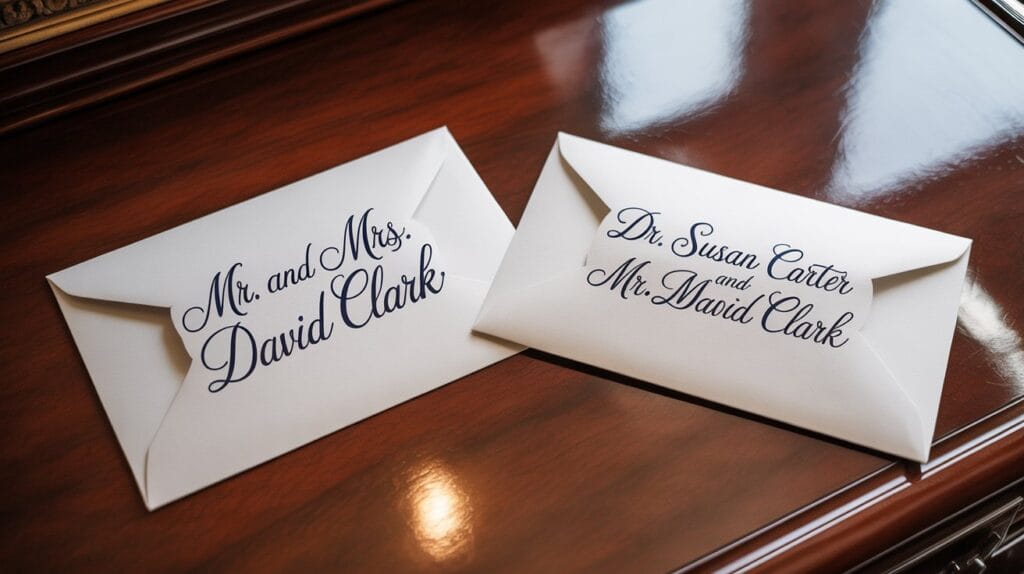
[Image Placement #2: A close-up, elegantly shot photo of two envelopes side-by-side. One shows a very traditional script (“Mr. and Mrs. David Clark”), and the other a modern script (“Dr. Susan Carter and Mr. David Clark”).]
Modern, Mindful, and Inclusive: Addressing Couples in 2025
Society has beautifully evolved, and so has our approach to etiquette. Today, it’s crucial to address couples in a way that reflects their individual identities and choices. Modern etiquette is less about rigid rules and more about respect. When in doubt, the most respectful option is always the best one.
Scenario 1: A Married Couple with Different Last Names
It’s increasingly common for partners to keep their last names after marriage. In this case, each person is acknowledged with their full name and title.
- Format:
Ms. Amelia Hayes and Mr. Leo Vance
Historically, the woman’s name was listed first. This is still a common practice, but listing the names alphabetically by last name (Ms. Amelia Hayes and Mr. Leo Vance) is also perfectly acceptable and a neutral choice. The key is to include both individuals fully.
Scenario 2: When One Partner Has a Hyphenated Last Name
Hyphenated names are also common. The approach is similar to addressing a couple with different last names—clarity and respect are paramount.
- Format:
Mr. David Clark and Mrs. Susan Miller-Clark
List each person with their chosen title and full name. This ensures you are honoring the identity each person has chosen to use.
Scenario 3: Addressing Same-Sex Married Couples
For same-sex couples, the same rules of respect and individuality apply. The goal is to acknowledge both partners equally.
- If they share a last name:
Mr. and Mr. Benjamin WrightorMessrs. Benjamin and Thomas WrightMrs. and Mrs. Eleanor VanceorMmes. Eleanor and Sophia Vance - If they have different last names: List their full names, either in alphabetical order or based on who you know better.
Mr. Benjamin Cole and Mr. Thomas SterlingMs. Eleanor Grant and Ms. Sophia Peterson
A simple rule of thumb for all modern addressing: If you’re unsure, just ask! A quick, polite text message saying, “Hey! I’m sending something your way and want to get the address just right. How do you two prefer to be addressed on mail?” is always appreciated.
Formal vs. Informal: Matching the Tone to the Occasion
The way you address an envelope to a married couple should directly reflect the event. You wouldn’t use the same tone for a backyard barbecue invitation as you would for a black-tie wedding.
For Formal Occasions (Weddings, Galas, Anniversaries)
Stick to the classics. Formality requires precision and tradition.
- Use full titles:
Mr.,Mrs.,Ms.,Dr. - Use full names: Avoid nicknames.
Jonathaninstead ofJon. - Spell everything out: Do not use abbreviations for streets, cities, or states.
123 Oak Streetshould be123 Oak StreetApt. 4Bshould beApartment 4BLos Angeles, CAshould beLos Angeles, California
For Informal Occasions (Holiday Cards, Thank You Notes, Party Invites)
You have much more flexibility. The goal is warmth and familiarity.
- Drop the formal titles:
David and Susan Clark - Use a family-focused address:
The Clark Family - Combine first and last names without titles:
Amelia Hayes and Leo Vance
This relaxed approach feels personal and friendly, which is perfect for casual correspondence.
[Image Placement #3: An infographic or a well-designed table titled “Envelope Addressing At-a-Glance.” It should have columns for “Scenario,” “Formal Address,” and “Informal Address” covering the main examples.]
The Inner Envelope: A Formal Tradition Explained
For very formal invitations, particularly for weddings, you may encounter an “inner envelope.” This is a slightly smaller envelope that goes inside the main (outer) envelope. It serves two key purposes: it further protects the invitation, and it allows you to be more specific about exactly who is invited.
The outer envelope is the formal one, following the rules we’ve discussed. The inner envelope is more personal.
- Outer Envelope:
Mr. and Mrs. David Clark - Inner Envelope:
Mr. and Mrs. Clark(More direct, drops the first name)
You can also use the inner envelope to clarify if children or a guest are invited.
- To invite children:
Mr. and Mrs. ClarkEleanor and Samuel(On the second line)
- To invite a guest:
Mr. Jonathan Pineand Guest(On the second line)
If the inner envelope only lists the couple’s names (Mr. and Mrs. Clark), it implies that only they are invited. It’s a subtle but effective piece of communication in the language of formal etiquette.
Frequently Asked Questions (FAQ)
1. How do you address an envelope to a married couple if you don’t know if the wife changed her name? When in doubt, use both of their full names with their own last names. Address it to Mr. John Smith and Ms. Jane Doe. This is the most respectful and safest modern approach. It’s better to acknowledge her birth name than to incorrectly assume she has taken her husband’s.
2. What is the most modern and inclusive way to address a married couple? The most modern way is to list both individuals by their full names: Ms. Jane Smith and Mr. John Smith. This acknowledges both partners as individuals. For same-sex couples, Mr. Adam Jones and Mr. Michael Smith follows the same respectful principle.
3. Should I use “Ms.” or “Mrs.”? “Mrs.” traditionally refers to a married woman who has taken her husband’s last name. “Ms.” is a neutral title that can be used for any woman, regardless of her marital status. If you are unsure of her preference or if she has kept her own last name, “Ms.” is always the appropriate and professional choice.
4. How do I address an envelope to a family with children for an informal card? For informal mail like a holiday card, addressing it to the entire family is warm and inclusive. Simply write The Clark Family.
5. Is it okay to use a printed label for a formal invitation? For a truly formal event like a wedding, handwritten addresses are strongly preferred. Calligraphy or neat handwriting adds a personal, elegant touch that a printed label cannot match. For more casual events or large-batch mailings like holiday cards, printed labels are perfectly acceptable.
[Image Placement #4: A photo of a person’s hands neatly writing an address on an envelope with a calligraphy pen, showcasing the personal touch.]
Final Thoughts: Address with Purpose and Respect
Learning how to address an envelope to a married couple in 2025 is more than just a lesson in etiquette; it’s an exercise in thoughtfulness. By taking a moment to consider the couple you are writing to—their professional titles, their last names, and their individual identities— you are starting your conversation with a powerful message of respect.
Whether you choose a traditional path or a more modern one, the ultimate goal is to make the people you care about feel seen and honored. Your effort will not go unnoticed. It transforms a simple piece of mail into a meaningful gesture that strengthens your connection.
What’s Your Go-To Style?
Now that you’re an expert, we’d love to hear from you! Do you prefer the timeless tradition of “Mr. and Mrs.” or a more modern approach? Share your favorite way to address envelopes in the comments below!